Showing posts with label debt. Show all posts

Saturday, July 6, 2013

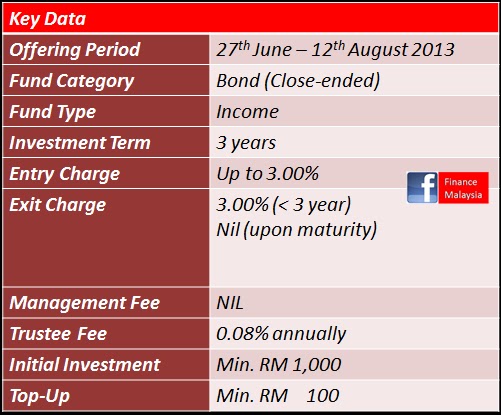
New Fund: Eastspring Investments Target Income Fund 2

In the current low interest rate environment, investors continue to chase for yields which resulted in strong demand for close-ended bond funds that potentially offers higher return than fixed deposits. Keeping this in mind, Eastspring Investments is launching a new fund.


The fund endeavors to provide regular income during the tenure of the fund (3 years), by investing in local and/or foreign debt securities.

Investment Strategy
A minimum of 70% will be invested in local and/or foreign debt securities, while the remaining of not more than 40% may be invested either in non-rated debt securities and/or debt securities rated below investment grade rating.

  • lower than BBB3 rating by RAM; or
  • below investment grade rating by other rating agencies

Although the fund is expected to invest up to 40% in non-rated issuers and/or issuers rated below investment grade, there is a risk that this limit may be exceeded as issuers of investment grade debt securities held within the portfolio may be downgraded by rating agencies and thus resulting in the fund's over exposure in such category.


Additionally, up to 30% may invested in money market instruments, and worth to note that the fund may exercise Early Repayment. As such, this is a moderate risk fund, instead of low risk.

The fund is suitable for investors who:-

  • seek regular income distribution;
  • have 3 years investment horizon; and
  • have a moderate risk tolerance.


Friday, July 5, 2013

Latest BNM measures to Curb Excessive Household Debt (July 2013)

Hot from oven. Bank Negara Malaysia (BNM) today announce some measures to address the alarming household debt among Malaysians. As reported, household debts have continued to increase at a strong pace, averaging at an annual rate of 12% over past 5 years. While this has been supported by positive income and employment conditions, in the more recent period, there has been a growing trend in the offering of financial products that are not in the long-term interest of consumers.


What does this mean?
This includes extended financing tenures of up to 45 years for house financing and 25 years for personal financing!!! Wow... Is it too long the tenure? While this may reduce the monthly repayments, in the long run, this increase the overall debt burden of households. If we don't stop this kind of practice, it will encourage excessive debt accumulation by households and increase the vulnerability of this sector.

Hence, BNM has to take actions...
The implementation of a set of measures aimed at avoiding excessive household indebtedness and to reinforce responsible lending practices by key credit providers. These measures, which take effect immediately, complements the earlier measures introduced since 2010 to promote a sound and sustainable household sector.


What are the measures?
  1. Maximum tenure of 10 years for financing extended for personal use;
  2. Maximum tenure of 35 years for financing granted for the purchase of residential and non-residential properties;
  3. Prohibition on the offering of pre-approved personal financing products.


Who will be affected the most?
For sure, borrowers (excessive one) will be short-handed. However, those good quality borrowers will not be affected. Meanwhile, the hands of financial institutions once again being tighten further. It will definitely impact the loans growth, but with a more quality growth. Property sector will face some minimal impacts, given most of the loan approved is within 35 years of financing.


For Finance Malaysia, this is good news for our country's financial sector. Excessive household debts, coupled with poor quality loans, will endangers the financial system. Worth to highlight here is the pre-approved loan is being banned now. Long time ago, Finance Malaysia is very uncomfortable with such offerings, with the intention to "indulge" bank clients to borrow. Now, we are relieve. Do you agree?

Tuesday, April 16, 2013

Consolidating Credit Card Debt: 2 Easy Methods in Malaysia


Credit cards have become a part of life in Malaysia. But as much as they make life a lot more convenient; credit cards can also lead to an unmanageable amount of debt. In some cases, credit cards have even led to bankruptcies.


If you have a credit card debt that seems to be spiralling of control, it may be the right time to consider debt consolidation. In Malaysia, there are two common debt consolidation methods that are highly workable.

1) Credit Card Balance Transfer

Credit Card Balance Transfers involve the transferring of money that you owe on your current credit card account to a new credit card.

Balance transfers offer a number of different benefits, including lower interest rate and the ability to simplify your credit card debt payment process. 

How Credit Card Balance Transfers Can Work for Debt Consolidation:

     If you have accumulated a significant amount of credit card debt, there is a good chance you are currently being charged the maximum interest rate. Based on the tiered interest rate structure adopted by banks in Malaysia, this maximum rate is generally 17.5% p.a.
     If you are paying the maximum interest rate, you are probably finding it quite difficult to keep up with your credit card debts. High interest rates can cause your credit card balance to rise quickly. For example, if the amount you owe on your credit cards is RM10,000, you are essentially adding RM146 in interest to your debt each month.
     A credit card balance transfer could give you a break from paying high interest. In some cases, you'll find balance transfer programmes that offer zero interest rate, at least for the first year or so. By taking advantage of one of these offers, you will have a better chance of paying your debt off.
     Banks often charge a once-off fee of 3% when transferring a credit card balance. However, in the long run you will still end up paying less, due to the lower interest rate.

Example of How Much You Could Save:

Credit card average maximum interest rate = 17.5%
Lowest known interest rate for balance transfer (for a limited time) = 0%
Amount you could potentially save on interest (for a limited time) = 17.5%

2) Personal Loan

The concept of taking out a personal loan in order to pay off credit card debts might sound a little unusual. However, if you take a strategic approach by taking advantage of interest rate differences between personal loans and credit cards, this method can actually work quite well.

How Personal Loans Can Work for Debt Consolidation:

     If you have accumulated a significant amount of credit card debt, there is a good chance you are currently being charged the maximum interest rate. Based on the tiered interest rate structure adopted by banks in Malaysia, this maximum rate is generally 17.5% p.a.
     The interest rates on many personal loans are far lower than credit card maximum interest rates. For example, some personal loan interest rates in 2013 can be 9.88% p.a. or less, depending on your loan amount and term. If you are a government servant, the rate dives even lower.
     If you take up a personal loan with significantly lower interest than a credit card’s, you could technically be paying much less over the long run. The savings you’re getting from your interest could even help offset the charges and fees associated with the application for a personal loan.

Example of How Much You Could Save:

Credit card average maximum interest rate = 17.5%
Known interest rate on a personal loan = 9.88%
Amount you could potentially save on interest = 7.62%

This article is brought to you by iMoney.my - the first website in Malaysia comparing credit cards, loans and mortgages - free of charge and independently.

Tuesday, July 3, 2012

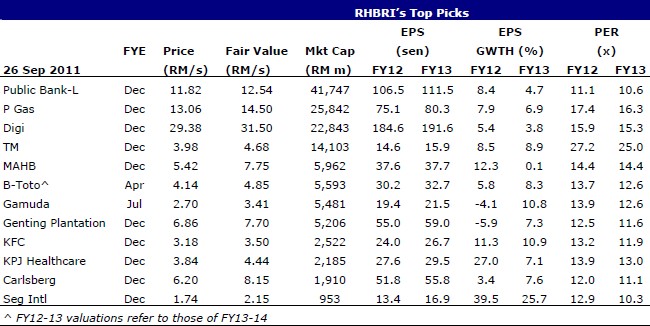
RHBRI: Market Outlook & Strategy 2H2012


In our view, the equity market will likely be stuck in a range-bound trading pattern for now, but will likely trend up as global economic uncertainties clear out towards the later part of the year. Investors’ key worries include :


  1. worsening of the euro-debt crisis that remains unresolved
  2. fears of China’s and India’s economies crashing down into a hard landing; and
  3. the risk of US falling off the “fiscal cliff”.

External Volatility And Impending Election 2 Key Headwinds

On the home front, the major event to watch out for is the impending general election that could also create volatility to the local bourse given the uncertain election outcome. Nevertheless, we believe the market will eventually trend higher towards end-2012, premised on:
  1. the ECB making a more decisive move to mutualise the debts of Eurozone governments;
  2. China policymakers ease policies substantially and its economic growth re-accelerates;
  3. US Congressional leaders cobble together some deals to mitigate the impact from the “fiscal cliff” and allay the fear of its economy falling off the cliff; and
  4. domestically, the general election produces a result where the ruling coalition party remains in control of the government.

Meanwhile, global financial markets are still likely to be awash with liquidity as central banks in advance countries have pledged to maintain extremely loose monetary policy and could unveil more quantitative easing programmes to support economic growth should the situation warrant. 


On the home front, the economy is more resilient than feared and we expect real GDP growth to stage a modest rebound to 4.7% yoy in the 2H, from +4.4% estimated for the 1H. In the same vein, net EPS growth for the market is projected to recover to +10.8% in 2012 before moderating to +7.8% in 2013. Consequently, we are maintaining our end-2012 FBM KLCI target at 1,650 based on 14.6x 2013 earnings.


Given global macro headwinds and general eletion risks on the home front, we believe it pays for the more discerning investors to hold some defensive stocks that have strong cash flows to pay sustainable dividends in their portfolios. In addition, we believe investors would still need to accumulate fundamentally-robust stocks on weakness in order to outperform the market. Sector-wise, our key overweight are telecommunications, consumer and banking, although we also have an overweight stance on the utilities, gaming and semiconductor sectors.


Source: RHB Research Institute

Friday, April 13, 2012

Why Government Should NOT Guarantee JCorp Debt Refinancing?

It's becoming confusing for many people, especially outsiders (non-Malaysian), as to the role of Government to Malaysian corporate. And, it had been more confusing when Government dishes out lots of Goodies to certain groups of people (as long as they are eligible voters) citing to help bring down the burden of Rakyat. Good reason though. However, many of us know that this may short-lived just because of the coming general election. Anyway, this is part of the political gimmick usually played around the world. Nothing's wrong.


One end, our Government targeted to bring down the deficit numbers by cutting subsidies like Petrol prices. But on the other end, it dishing our cash just like what announced during Budget 2012, citing Government had made encouraging improvements in collecting taxes. Then, why not bring down the budget deficit of the country first? Does few hundred ringgits really make huge different for people?

A BAD example set by JCorp?
The latest movements by Government in corporate world is by GURANTEEING a fundraising exercise by Johor Corporation (JCorp) that will help the state agency to meet its immediate debt obligations.

JCorp, the strategic investment arm of Johor, announced that it planned to issue a sukuk wakalah Islamic finance instrument worth RM 3billion to be directed at redeeming the state-owned corporation's outstanding bonds worth RM3.2billion maturing at end-July. This is not an usual treatment by Government in providing support for fundraising schemes directed at refinancing existing debt.

Subsidiaries of JCorp

Why this may Backfire?

  1. Bankers and investment analysts said the Government's move for JCorp sets a potentially negative precedent because it could encourage other financially distressed state agencies to propose similar debt restructuring programs. (source: TheEdge)
  2. Guaranteeing means Government is liable for the fundraising exercise when things turn sour.
  3. Does Government study thoroughly before guaranteeing? If the said corporate perform well, why it needs Government's backing? Is it because of high debt to asset ratio that scared away financial institutions?

By looking at the stable of companies under the umbrella of JCorp, Finance Malaysia don't think that it will go burst easily. However, the above concerns must be addressed to avoid future backfire. When state agencies doesn't do well, it definitely will affect the economy, subsequently Government. This is just a wake up call for relevant parties. Let's jom KFC...

Monday, February 20, 2012

Who can Save GREECE? (Feb 2012)

It's the time again for Greece to convince its counterparts that they are serious in cutting budget deficits. By doing so, Greece was to put on the lifeline (bailout) by European Union (EU) once again. The discussion of whether to save or not to save Greece had been dragging for one week time now. Why?


In Chinese, we say "we cannot see people die by not lending our hand". That's why China said they will help when the time arrives. The question is when is the right time? Until Greece go bankrupt? Or,  until Greece left EU?

Who can save Greece?
The answer to this very important question is very obvious. In Christian, they always emphasize on "we should take responsibilities on what we did", right? So, the solution lies in Greece hands. Not the country, but, the citizen, the people of Greece. It's time for them to come back to reality. Let's take Malaysia as a benchmark, they are working fewer hours than us, yet they are earning much better than us. GDP per capita of Greece is more than twice of our figures. How are they going to sustain whatever they are having now, such as attractive pension scheme and healthcare?


Technically, Greece already bankrupt with Debt to GDP of over 140. What does this mean? For every RM1 they earn, they spent RM1.40. It's overspent, it's over leveraged. It's time for Greece to unite together, shoulder the responsibilities with their Government, by taking pay cut, reform the pension scheme and healthcare system. By doing so, then only Greece can come out from debt crisis. Although the period is difficult, they must did it, don't procrastinate anymore. The longer they drag, the debt may snowball until a stage where "too big to burst".


Finance Malaysia really hopes Greece can come out of the bad times by themselves proudly. This goes to Italy, Belgium, Ireland, and Portugal too. We shall support Greece by visiting the beautiful country (of course, until all the riots were end).

Monday, December 5, 2011

The end of Europe’s liquidity crisis? (Dec 2011)

Well, many people already bored with the on-going Europe debt crisis, and subsequently liquidity crisis. This is like what we have seen in 2008 when Lehman Brothers collapses, which drags down the whole financial systems globally through liquidity crisis. The different is between company and country. Maybe some of us doesn't know how this chain effects rattles the global markets. So, let us start here.

The European Organisation chart of Debts
The root of the problem plaguing the market right now is Europe debt crisis, where Greece and few other European countries were highly in debts. They just simply cannot generate enough revenue (taxes) to support the economy itself. So, they resorted to seek for funding via borrowing by issuing sovereign bonds to finance their day to day operations. However, the debt is piling up intensively after 2008 global financial crisis until recently. Because the government does not have money, their bonds may go into default. So, they were forced to borrow some more, but with higher interest this round.

For them, this kind of measures are simply to prolong the problems and those debts were still there charging higher and higher interest. They are buying time, hoping their economies will survive and growing in the future to repay back whatever they borrow now. What a pretty picture?

Who is the main borrower?
Congratulations, the winners go to French banks. They are the main source of funding for these troubled ladden countries. As long as these banks charges those countries interests, everything is good for banks but bad for countries. What if those countries really go bankrupt? French banks may follow suits too.

So, the pretty solution is to write-off from the book of borrowers (French banks). Why French banks still need to accept the offer? Depending on the % of write-off, banks at least got something better than nothing. Right?


How the liquidity problem set in?
Debt writing-down means that the assets of French banks were being slashed. Last month, there is a 50% hair-cut for Greek debts and the amount will reflects in the books of these banks in the next few quarters. Now, you know why rating agencies are cutting 15 European banks' rating last week?

Sigh... But, not yet ends?
After the hair-cut, banks may having liquidity issues next. They doesn't have enough capital to borrow and this may dampened the whole financial system, thus, businesses and public facing difficulties to finance their expansion or consumption. Don't worry, angels were always by our side.

Angels (not Santa) come before Xmas...
Last week, 6 central banks globally take an important step toward dealing with the problems in Europe by pledging to continue provide funding to global banks (especially European banks). These angels are US Federal Reserve, the Bank of Canada, the Bank of England, the Bank of Japan, the European Central Bank, and the Swiss National Bank. They would lower the pricing on US dollar liquidity swap arrangements effectively easing the liquidity problems faced by European banks.


This action dissolves one of the stumbling blocks in global financial system. Risk plays a role when one bank lends to another. In the current environment, banks likely don't believe that they are being compensated enough for the risks they face by lending out. With the dollar swap lines, banks can instead go to their central banks for short-term loans, provided that they have good collateral. Win-win situations? Yup. I think so because one can solve the liquidity problem, while US successfully creates a huge demand for its sliding currency.

Thursday, October 27, 2011

Will Thailand flooding with Debts after this?

Oh my god. Another disaster has occurred, and this time is Thailand's turn. Finance Malaysia would like to offer condolences to Thailand for its massive damage caused by floods. This is not an ordinary floods, please read the numbers below then you will know.

  • worst floods in 50-years!!!
  • more than 300 lives gone
  • affecting nearly 9,000,000 people


Started weeks ago at upper Thailand, the floods were spreading down to its capital - Bangkok - now. Bangkok has more than 12 million population. The situation can only get worse from here and everyone is fleeing the city, searching for higher grounds and off to vacation. People are snapping up dry foods, fresh waters and daily products, hoping to brace through the difficult periods.

Will Thailand went into recession?
With Bangkok being the major engine of the country, many economists are expecting that the strong flooding in Bangkok would severely impact Thailand's GDP growth. Bank of Thailand (BOT) already downgrading their growth forecasts for this year to below 4%. Not yet negative, thanks to the first half of 2011. So, no recession yet unless there is not drastic measures taken by the newly elected government.

How serious is it?
First, the industrial parks in Ayutthaya provinces where houses many factories of multi-national companies are heavily impacted by floods. Obviously, Japanese automobile manufacturers being the hardest hit. Honda and Toyota already shut down their productions. Together with other companies situated there, their earnings sure will be affected.

Second, banks will be impacted by higher non-performing loans (NPL), in which companies and borrowers affected may not able to repay their loans.

Third, businesses in the city closed doors to prevent flash floods and riots that may happened. Domestic consumption will slow, very slow.

Forth, agriculture land was damaged. This will severely impact those rural people, and they have to takes weeks (if not months) to resume their activities.

Fifth, slowdown in sales for property developers is inevitable.

Sixth, flights and other transportation services disrupted led to earnings downgrade on companies such as airlines.


How about its impact to other countries?
While it was a bad experience for Thailand, other countries may benefiting from this episode such as Malaysia and South Korea. Why? Simply because those affected companies may swift their operations to other countries. Then, why Malaysia and Korea?

The most affected companies is from Japan, dealing in automobiles, digital camera and hard disk drive businesses. So, Japanese companies may potentially swift their operations or supply chains, either temporary or permanently, to Malaysia due to its strategic location and labor markets. 

Other than that, South Korea also is an ideal place for Japanese companies. We have seen this after the Japanese tsunami and nuclear crisis this year. This is not new anymore. Some interesting growth may surfaced in the automobiles and technology sector in South Korea.


What should be investors' positioning right now?
Generally, I don't think that Thailand will go into recession. Slowdown Yes. Thailand has more than enough financial resources to rejuvenate their economies. The rebuilding exercise should not be a problem. What we concern most is the execution part (just like Japan). For this investors should keep investing in Thailand selectively. Avoid banking, automobiles, agricultural and property sectors. Instead, hunt for those attractively priced counters in building materials, construction and healthcare sectors.

Countries wise, chose Malaysia and South Korea for the above mentioned reasons.

Wednesday, October 12, 2011

Why Gold Price DROPs lately? (Oct 2011)

During market uncertainties, there are two popular safe assets which is Gold and USD. This explain why the demand for these two assets is great, resulting them to become more valuable while equity market fell. We experienced the said scenario recently and let's see the chart below to gauge the Gold price movements.


"Gold prices collapsed from their August highs in September amid a broad commodity sell-off and despite intensifying concerns over sovereign debt issues in Europe. After exhibiting a remarkable correlation to real rates this year, particularly during the swift August rally, the sharp pullback in gold prices occurred with real rates mostly unchanged."


"Gold prices have now fallen back in line with our 3-month price target. As we expect gold prices will continue to be driven in large measure by the evolution of US real interest rates and with our US economic outlook pointing for continued low levels of US real rates in 2012, we continue to recommend long trading positions in gold and reiterate our 12-month price target of $1,860/toz", reported Goldman Sachs.

Why is it different this round?
Supposedly, gold prices should move in-line with USD. But, we see USD strengthening to months high while gold prices faced some setbacks lately. We at Finance Malaysia would like to guess the off-the-screen factors such as...

First, who is holding the most gold?
Second, who is in dire needs to sell gold reserves?
Of course, European countries (highlighted in yellow)


Now, you know why gold prices behave differently? Ha...ah. We are not surprise by the sell-down (if any), given the high valuations gold fetches when it recorded all-time high almost every days until $1,900/toz. Does Gold more important than cash right now? Yes for China, No for Europe.

Sunday, October 2, 2011

RHB: Market Outlook & Strategy 4Q2011

Titled "Perilous Crossroads; Challenging Times Ahead" RHB Research painted a not so rosy 4Q2011 outlook for KLCI. Undeniably, our market are in for a turbulent times and we do not know how the year will be ended. Bear or Bull market?


Below is the excerpt from the said report:

~ The US economic recovery has slowed to a crawl, while Europe is not just lurching from one crisis to another, it is lurching into a new one before the previous one is solved. There is growing risk that sustained weak confidence could exert downward pressure on demand and business activity worldwide.


~ Nevertheless, "double-dip" recession can still be avoided if political leaders get their acts together fast enough to contain the debt crises and avert a contagion given that global trade has not fallen off the cliff.

~ On the home front, we expect the Government to speed up the implementation of the Economic Transformation Programme, which coupled with resilient consumer spending, will provide some cushion to the weak external demand for the country's exports.

~ RHB has revised down our 2012's economic growth projection to 3.6% from 4.5% previously and compared with +4.3% estimated for 2011.

~ With a still cloudy global economic outlook, we believe it is still too early to "bottom fish" at this stage. As global headwinds remain strong and situations could get worse, we will continue to advocate a defensive investment strategy for investors.

~ Under such circumstances, we are of the view that high dividend yielding stocks with reasonably good growth potential would be more resilient and will likely outperform the overall market.


Friday, September 23, 2011

Western Debt Crisis: Bursting of Volcano? (Sept 2011)

We cannot deny that we are in for another round of hard times since 2008 global financial crisis. Some experts are saying that we are facing the Great Depression wave coming in the next few months, if no concrete efforts put in by global leaders. Meanwhile, some experts think that opportunities arises again and put off the double-dip recession speculation.


The downgrading of US's AAA rating re-ignite the fears over the sustainability of its sovereign debt. However, please be mindful that US rating remains extremely sound and reflecting a very low risk of default in the long term, still. USD remain the preferred and most widely traded currency in the foreseeable future, and there is no reason to worry about.

Sovereign Risk scaring investors away?
Meanwhile, in Eurozone, the situation remains very complex and greater political will is needed to maintain Euro as regional currency. Between Eurozone breaking up and resolving the situation, which one is easier? Of course, the economic and financial cost of the Eurozone breaking up seems far higher.

Undoubtedly, the "Volcano" is active again now and may burst anytime from now. Unless, we poured ice on it to prevent the crisis. Sorry, we needs ICE-BERG (great efforts) to get through it. Otherwise, we may just let it burst, and start all over again. Not a bad idea though, right?

I can say it that way because I am living in Asia right now. Luckily, Asia is much more resilient comparing to its western friends, partly due to the 1997 Asia financial crisis which make our banking system strong and pro-active now. Our lessons were being taught to western countries this round. Hopefully, they know the root of the problem and tackles it painfully.

Monday, August 8, 2011

Disaster after US rating downgrade? (8 Aug 2011)

The news that S&P downgrading US credit rating shows that rating agencies are doing their job fairly. Previously, rating agencies were blamed by Greece and Europe countries for downgrading their ratings when Greece facing rising debt issue. Though, US did not spare this round when S&P downgrade US AAA rating to AA+ (one notch lower).


What would be the implications?
Normally, the downgraded currency will slump, sovereign bonds will become less attractive by carrying higher degree of risk, hence pushing up the yields. Does US follow these theory? NO.

Why US is different?
USD will not fall much like Euro. First, USD is one of the safest asset, along with gold, during economic uncertainties. That's why USD was chosen as the world's most widely traded currency. During uncertainties (like now), investors are scare and they pull-out from equities around the world. But, where did they put the cash? USD is the answer mainly because it is widely used globally and of high liquidity.

Bond Yield will not jump like Greece's. Second, when the demand for USD is still there, US treasury bonds' yield will remain (or even fall). Continuing from previous question, where would you place your money, if it must be denominated in USD? Treasury bond or Cash Deposit? Definitely treasury bonds which still can give you around 2.5% yield (10 years US treasury).


The remaining AAA rated currency by there of the largest rating agencies.

How is the currency market would be?
Finance Malaysia believes that USD will weaken against major currencies which were rated AAA, but will strengthen against other non-AAA countries (including Malaysia). You may refer to the table above to gauge which currency should perform better in the near term.

Sunday, July 31, 2011

What if US failed to increase Debt Ceiling? (31 July 2011)

Deadline gets closer and closer, yet US have not come out a concrete solution to calm the world. Whether tax increases should be included in a deficit reduction agreement or not, both Democrats and Republicans are standing firm without compromise. Republicans insist that any deal to cut deficits should involve spending cuts only while Democrats have been demanding both spending cuts and tax increases.


Although Finance Malaysia reckons that the Congress would pass the bill to increase debt ceiling, let us analyzed and prepare for the unfortunate outcome. What if the debt ceiling limit is not raised by 2nd August?

  1. US bondholders will get paid first, while other payments such as social security, military payment, and Medicare services will stall.
  2. Downgrading by rating agencies is unavoidable, which will lead to an increase in Treasury's borrowing costs.
  3. US will be losing its AAA ratings, damaging the important role of USD as one of the world's preferred currency.
  4. USD will slump to yet another all-time low, while Gold price will recorded yet another all-time high
  5. Commodities prices traded in USD will shoot up.
  6. Inflation rate in Emerging Markets will pushed up by rising resources and food prices.
  7. Hence, this will dampen the growth of the economy and China being the world's growth engine will stall by high inflation, lower domestic consumption.

It's such a nightmare for the world's economy. Anyway, Finance Malaysia thinks that both Democrats and Republicans will reach a solution and pass the debt limit increase. Ultimately, who is going to blamed for if US default? Both sides of politicians, not only Obama. The world is just not prepared for such unfortunate events while recovery is just started.


Saturday, July 30, 2011

US Debt Ceiling: What is that exactly?

Time is running out. We still have 3 more days to the very decisive day of 2nd August 2011 for US politicians to reach an agreement to increase the US debt ceiling. Everyday we heard this word "Debt Ceiling" repeating be it via TV, radio, newspaper and social media, but do we exactly know what does it mean?
Once again, Finance Malaysia blog strive to provide the knowledge to public regarding the most discussed economic issue now. So, what is debt ceiling?


The debt ceiling is a cap set by Congress on the amount of debt that the federal government can legally borrow. The cap applies to debt owed to the public plus debt owed to federal government trust funds such as those for social security and Medicare.

Why US need debt ceiling?
With debt ceiling, US can only borrow to finance their budget with the limit given. This will put a stop on the amount US can borrow to avoid US from over borrowing, which is very dangerous for the economic health of US.

What is the current limit?
The current limit was USD 14.29 trillion, which was raised in Feb 2010. It was not the first time, yet it would not be the last. The first limit was set in 1917 with USD 11.5 billion. Since then, it has been increased nearly 100 times.


Sunday, March 20, 2011

New Rules on Credit Cards: NO Credit for LOW Credit?

New Measures on Credit Cards had been announced by Bank Negara Malaysia (BNM) to promote prudent financial management and responsible business practices. Summary on the announcement made:
  • For new credit card holders, minimum income eligibility is set at RM24,000 p.a
  • For cardholders earning RM36,000 p.a and less, the following would be applicable:
    • Cardholders can only hold credit cards from a maximum of 2 issuers
      • Affected existing cardholders are given up to the end of 2011 to select their preferred issuers.
      • Cardholders will also be given at least 2 years to service their outstanding credit card debt for the credit cards that have been canceled for the purpose of meeting this requirement.
    • The maximum credit limit extended to a cardholder shall not exceed 2x their monthly income per issuer.
      • For affected existing cardholders, a grace period of 2 years will be given to them to meet with the new requirement.

Example of Credit Cards
How about credit card issuers?
  • Credit card issuers are required to adopt fair, transparent and responsible approach in marketing and offering of credit cards to consumers
  • Can issuers increase cardholders' credit limit without obtaining their consent? NO
  • Can issuers offer a credit advance in the form of cheque payable to cardholders, if they did not request for it? NO

Ease of comparison and making decisions...
  • Issuers to provide a Product Disclosure Sheet that contains key information on the card's features, fees and obligations of the cardholders.
  • Issuers to display prominently alerts to communicate to cardholders the implications of meeting only minimum and partial repayments.
  • Annual statements will be issued at the end of each year, providing information on how long it will take to fully pay off the cardholder's outstanding balance and the total interest costs if only minimum repayment made.

How to make Credit Card Infrastructure more Secure and Safe?
  • Effective 1 January 2012, transaction alerts via Short Messaging Service (SMS) will be implemented after each transactions are performed
  • Effective 1 January 2015, Personal Identification Number (PIN) verification for all card transactions will be implemented
To make our Credit Card safer

Finance Malaysia have a say
The eligibility starts from minimum RM2,000 per month salary is good. We should not give credit to those lower income group as that will only encourage them to spend with credit. But, the maximum credit limit of 2x monthly income is somehow too conservative. In fact, issuers are giving 3x credit limit currently, which is deemed reasonable. 
Problem arise when we purchase a laptop worth RM2,500 for example, and opt for 0% interest repayment scheme. Even though we are capable to repay, but the credit limit balance is reduced by RM2,500 straightaway, and it left very little only.

Understandably, the measures is introduced when Malaysian households debt is considered very high currently. Overall, it is good for the banking systems, and I believe Malaysians welcome the extra security features to be imposed to instill confidence of public on the usage of credit cards.

Source: Bank Negara Malaysia