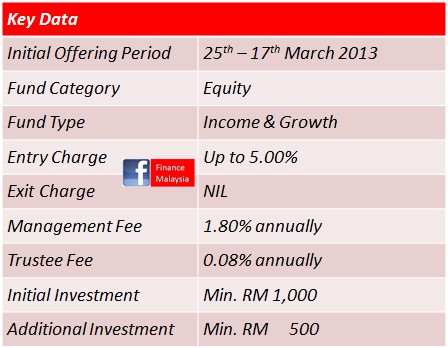
Showing posts with label Unit Trust. Show all posts

Thursday, July 25, 2013

New Fund: Kenanga Asia Pacific Total Return


After merging with ING Funds Berhad, Kenanga Investors Berhad launched its first new fund of the enlarged family. In this uncertain global economic environment, how much return can a fund generated was the main concern for many investors. Want to get higher return? Then, we cannot runaway from higher volatility! Are there any balance in between?


Yes. To cater for such investors, this new fund aims to provide a compounded rate of return of at least 10% per annum over market cycle (5 years) by investing in a diversified portfolio of Asia Pacific equities.


3 Reasons WHY it benefits you:


Well... Unlike others, this fund DO NOT has any benchmark constraint. This allows flexibility in identifying and implementing the most optimum investment strategy. Picture below shows the differences between Absolute and Relative return:

Still not yet convinced? How about the proven track record?


Source: Kenanga Investors Bhd

Thursday, July 11, 2013

New Fund: AmAsia Pacific REITs Plus

Do you remember the AmAsia Pacific REITs fund? I'm sure you have heard about it. Yes, backed by its success story, AmInvestment Management Bhd has launched a new version called AmAsia Pacific REITs Plus. The word "Plus" is used as a continuation of the AmAsia Pacific REITs and the fund may invest in listed equities in the real estate sector.


The fund aims to provide regular income and to a lesser extent capital appreciation over the medium to long term (at least 3 years) by investing in real estate investment trusts (REITs) and equities in the real estate sector.

What's the strategy?
Minimum 70% in REITs and a maximum of 29% in listed equities in real estate sector, which are in the Asia Pacific region. This is the asset allocation of the fund. Diversification in terms of country and different REITs sub-sectors (etc. residential, commercial and industrial) is expected.


An active allocation strategy will be employed by fund manager, based on macroeconomic trends and REITs market outlook of respective countries in Asia Pacific region. Meanwhile, bottom-up security selection strategy will be used for equities, with focus on undervalued companies.


Who is suitable for this fund?
  • Those who wish to have investment exposure in real estate sector through a diversified portfolio of REITs and real estate equities in Asia Pacific region.
  • Those seeking regular income and to a lesser extent capital appreciation over medium to long term
What's AmInvest aiming?
4% payout on yearly basis, which AmInvest said is achievable and is higher than fixed deposit rate offered by banks. AmInvest favors Australia, Singapore and Japan for REITs and China, Indonesia and Thailand for listed equities.

Saturday, July 6, 2013

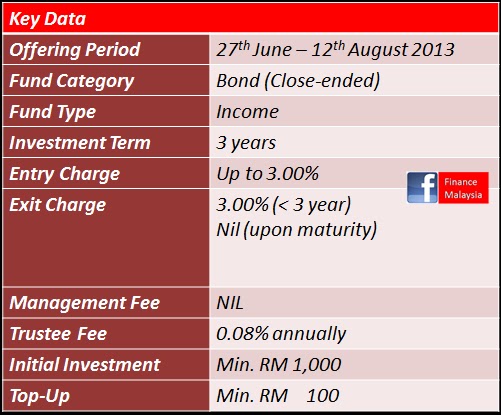
New Fund: Eastspring Investments Target Income Fund 2

In the current low interest rate environment, investors continue to chase for yields which resulted in strong demand for close-ended bond funds that potentially offers higher return than fixed deposits. Keeping this in mind, Eastspring Investments is launching a new fund.


The fund endeavors to provide regular income during the tenure of the fund (3 years), by investing in local and/or foreign debt securities.

Investment Strategy
A minimum of 70% will be invested in local and/or foreign debt securities, while the remaining of not more than 40% may be invested either in non-rated debt securities and/or debt securities rated below investment grade rating.

  • lower than BBB3 rating by RAM; or
  • below investment grade rating by other rating agencies

Although the fund is expected to invest up to 40% in non-rated issuers and/or issuers rated below investment grade, there is a risk that this limit may be exceeded as issuers of investment grade debt securities held within the portfolio may be downgraded by rating agencies and thus resulting in the fund's over exposure in such category.


Additionally, up to 30% may invested in money market instruments, and worth to note that the fund may exercise Early Repayment. As such, this is a moderate risk fund, instead of low risk.

The fund is suitable for investors who:-

  • seek regular income distribution;
  • have 3 years investment horizon; and
  • have a moderate risk tolerance.


Monday, July 1, 2013

New Fund: OSK-UOB Capital Protected Essentials Fund

As the world population continues its growth led by the emerging countries coupled with the higher purchasing power, the demand for the essentials or basic commodities (i.e. those that we use daily such as cotton for clothing, corn and sugar for food, crude oil for energy) have significantly increased. Further, with the imbalance of increase in demand and slower growth in supply, this has also resulted in a situation where consumers now and going forward have to pay more for fuel, clothing and food.


With the expectation of further increase in the prices of these essentials or basic commodities, OSK-UOB has established a fund that will capitalize on the price movements of these essentials or basic commodities, which is OSK-UOB Capital Protected* Essentials Fund.

Fund Asset Allocation:

Indicative Asset Allocation


Over The Counter (OTC) Option:
A 4-year option whose underlying reference is a basket of 4 commodities, i.e. Brent Crude Oil, Cotton, Sugar and Corn, and each commodity is represented by a listed futures contract.


Why it also called "Memory Option" ?
This is because the option is structured to provide 4 annual coupon payments during the tenure of the fund, if at the relevant observation date, all of the 4 underlying reference commodities prices are greater than or equal to their initial reference prices determined at the commencement date of the fund. It has a "memory" component i.e. the annual coupon payable can be carried forward if it failed to met the conditions for a particular year.

103% Capital Protection?
Yes. The capital protection covers the investors' capital investment and includes the 3% sales charge payable by investors.

Hence, the fund is suitable for investors who:


  1. have a low risk tolerance;
  2. seeks capital protection*;
  3. seek potential returns from commodities essential to our daily lives;
  4. have a medium term horizon; and
  5. seek income


Source: OSK-UOB Investment Management


* Investors are advised that the fund is not a guaranteed fund. Capital protection is provided through investments in ZNIDs and not by a guarantee. Consequently, the return of capital is SUBJECT TO the credit/default risk of the issuers of the ZNIDs and may result in losses.

Friday, May 17, 2013

New Fund: OSK-UOB Absolute Return Fund

With market continuously rotating between "risk-off" and "risk-on", an absolute return mandate with the adoption of a dynamic asset allocation approach would be a good vehicle to ride out the volatility. With the fixed income market having outperformed over the last 5 years, there is a high possibility that good quality equities - those with earnings growth and clarity supporting healthy dividend payouts would find favour.


This is a wholesale fund which aims to achieve medium to long term (3 - 7 years) capital appreciation through investments in equity and equity related securities of companies, and exchange traded funds with the potential to deliver total return in excess of the fund's benchmark return (8% growth per annum).

Investment Strategy
Asia Pacific region (excluding Japan) will the focus of this fund, either through equity or equity related or exchange traded funds. The manager views the region as a vibrant economic growth region supported by factors such as favorable demographics, improving per capita incomes, positive foreign direct investment flows, and vast natural resources.

The strategy is to identify such investment opportunities in its early phase and select companies with strong fundamentals and attractive valuations to capitalize on its growth. Undervalued securities are uncovered through intensive and independent fundamental research.


A Barbell approach - buying dividend yielders coupled with growth (and cyclical) & value stocks would provide a combination of steady cash flows and capital appreciation. This new fund to some extent would allow the portfolio managers to focus more on stock picking without ignoring developments at the macro level.

Meanwhile, the fund's asset allocation is totally flexible between equity and fixed income / money market, depending on economic conditions.


Wednesday, March 13, 2013

OSK-UOB Dana KidSave

One of the most desired by an investor, is to achieve diversification in his or her portfolio and what better way to do so then by investing in a balanced fund. A balance in an investment portfolio is also fundamental to appease an investor in times of uncertainties and volatility. Such a balance can appeal to the investor of any age regardless of his or her objectives. Thus, with market uncertainties continuing to prevail over the Eurozone debt crisis and its contagion effect on the global economy, investors remain cautious with their investment choice, seeking to invest in low to moderate risk investments such as a balanced fund.


Hence, OSK-UOB offer you a Shariah-based fund with its balanced asset allocation strategy in equities and investments comprising sukuk, islamic money market instruments, deposits and collective investment schemes. The investment in equities will enjoy potential capital appreciation upswings while any downswings will be cushioned by its investments in the latter which are defensive in nature.


When making investments, the manager may invest up to 30% of NAV in foreign markets. The fund will invest in Shariah-compliant securities/instruments listed on or traded in Asia Pacific ex Japan markets, including Shariah-compliant securities / instruments of companies that are listed on or traded in non-Asia Pacific ex Japan markets (such as NYSE and LSE).


How about Sukuk ?
At lease BBB rating sukuk issued by Malaysian incorporated companies at the point of purchase by RAM Rating Services Bhd or equivalent rating agencies. Foreign sukuk issued by corporations and financial institutions must carry a rating of BB or higher by S&P or equivalent, whereas sukuk issued by supra-nationals, governments and their agencies need not be rated.


Source: OSK-UOB IM

Tuesday, March 12, 2013

New Fund: Hwang AIIMAN Select Income

After the successful performance of AIIMAN series and the superb proven track record of Hwang Select Income fund, it's natural for Hwang to launch this new fund by riding on the story of these.


What is the Hwang AIIMAN Select Income fund?
This is a Shariah-compliant mixed asset (conservative) income unit trust fund that seeks to provide investors with regular income stream through Shariah-compliant investments. It also serves as an alternative investment for investors looking to diversify their portfolio into the fast growing Sukuk market and attractive Shariah-compliant equity market.

What it offers you?

  1. Potentially Stable Returns and Regular Income by investing in prudently selected Sukuk and quality dividend yielding equities.

  2. Peace of Mind: Managed at Low Volatility rates. It aims to deliver positive returns at low volatility rates through various market cycles.

  3. A Diversified and Shariah-compliant Investment. Potential for enhanced return due to the opportunity to tap into new attractive Shariah-compliant investment in view of growing demand for Islamic securities, growth fueled by ample liquidity in the Gulf Corporation Council (GCC) and Asia, coupled with the increasing sovereign Sukuk issuers.


Source: HwangIM

New Fund: AmAsia Pacific Leisure Dividend

Do you like to go on a holiday spree in Asia Pacific region? If yes, then this fund may suit your appetite. On top of that, you can expect some dividends from this new fund launched by AmMutual. Please read on.


The fund aims to provide regular income and to a lesser extent capital appreciation over the medium to long term by investing in equities and equity-related securities of leisure industry across Asia Pacific region.


To achieve its objective, the fund seeks will be investing 70%-98% in a diversified portfolio of equities related to leisure industry. Who were they? They may include issuers engaged in the design, production and distribution of products and services related to leisure industry. These companies operate in the following sectors within the leisure industry such as hotel, retail, publishing, advertising, beverages, audio/video, broadcasting radio/television, cable and satellite, motion picture, recreation services and entertainment, toy, gaming and tobacco.

Where were they?

These companies are listed in the Asia Pacific region, which includes but not limited to Australia, Hong Kong, Malaysia, New Zealand, Singapore, South Korea, Taiwan and Thailand. However, the fund will not invest into Japan.


Investment Strategy...

The investment manager combines top-down asset allocation process with a bottom-up security selection process. The asset allocation will be reviewed periodically depending on the macroeconomic, industry trends, respective country's economic and stock market outlook. The asset allocation decision is made after a review of macroeconomic trends in Asia Pacific economies. As for bottom-up security selection, the investment manager will focus on undervalued companies which demonstrate sound corporate fundamentals, which are expected to provide dividends yield above market average, and sustainable dividend yield on a medium to long term basis. Stock valuation fundamentals considered are earnings per share growth rate, return on equity, price earnings ratio and price to book multiples.


Source: AmMutual

Tuesday, March 5, 2013

3 Different Types of PRS Distributors

Finance Malaysia believes that after a series of publicity and roadshow by various parties, especially PPA and PRS providers, you should know what is Private Retirement Scheme (PRS) is all about. Since then, we received many inquiries on whom should potential contributor consult with and why?

It brings us to this topic, and hopefully by understanding the different types of PRS distributors, investors could make their decision confidently. There is no right or wrong. It's down to your own preferences and of course, the trust level you have on a PRS consultant. So, who are they?

  1. PRS consultant
    This is the most common practice in town, whereby a PRS consultant representing one PRS provider. So, in this case, he/she can only distribute PRS from one company.

  2. Institutional PRS adviser
    Basically, they are bankers whom also licensed to distribute PRS schemes made available by respective banks. Bankers may distribute schemes from more than one PRS providers.

  3. Corporate PRS adviser
    Currently, only financial planning firms holding this kind of licensed, whereby they can represent and distribute products from more than one PRS providers. They are individual acting on behalf of clients to source for the most suitable schemes for contributors.

Please take note also that not all unit trust consultants can distribute PRS. ONLY those already get their PRS license can distribute. Under the guideline, he/she may represent a PRS provider, which differ from his/her existing unit trust company. Example, a Public Mutual unit trust consultant can holds a PRS consultant license by Manulife. In this case, he/she can ONLY distribute Manulife PRS to clients.

According to Alex Yeoh (email: alexyeoh@vka.com.my), a licensed financial planner with a corporate PRS adviser, thinks that each channel has its own advantages. In the end, clients would choose the one, who can give them the best service they want.


Finance Malaysia hopes the above info is useful for you to make informed decision. We believe service of adviser/consultant plays an important role in PRS distribution. However, if you intended to have different PRS funds from different PRS providers, it would be advisable to seek help from a corporate PRS adviser. It's more convenient, simple and effective. Thank you.


Saturday, February 23, 2013

New Fund: CIMB-Principal Enhanced Opportunity Bond Fund


They say that the only constant in life is 'change'. Well, not always. Hopefully, with this new fund, you will find comfort in its stability. Furthermore, it aims to provide more returns than the current Fixed Deposit rate, and is more stable than equities. Riding on the growth of the Asian countries, investors have the opportunity to diversity their portfolio and increase the returns. This fund is only available until 4 April 2013 !


What is CIMB-Principal Enhanced Opportunity Bond Fund?
It is a close-ended fund that aims to provide investors with total return through investments in a portfolio of debt securities primarily in bonds. The fund seeks to achieve its overall objective by providing total returns consisting of a combination of interest income and capital appreciation


Investment Strategy

Under general market conditions, between 70% to 99% (both inclusive) of the Fund’s net asset value (“NAV”) will be invested in non-ringgit debt securities primarily in bonds (including convertible bonds). Of the 99%, up to 40% of its NAV may be invested in unrated securities and high yield securities respectively while the remainder will be invested in investment grade securities. These investment grade securities are issued or backed by governments, government agencies, supranational organizations, corporate or other issuers. At least 1% of the Fund’s NAV will be maintained in the form of liquid assets such as bank deposits for liquidity purpose.

However, in the event of limited non-ringgit debt securities, the fund manager will have the discretion to invest in the ringgit debt securities primarily in bonds with yield at the prevailing market condition, if the fund manager is of the opinion that by doing so is in the best interest of the Fund.


While the Manager intends to adopt a buy-and-hold strategy for the Fund whereby the securities purchased will be held for the tenure of the Fund or to maturity of the securities,
the Manager reserves the right to deal with the securities in the best interest of the Unit holders in the event of a credit rating downgrade.


The Fund is suitable for investors who have three (3) years investment goals and are not planning to have access to their money in the next three (3) years. It is also suitable for investors who are seeking exposure to investment opportunities in debt securities.


Source: Fund prospectus

Wednesday, January 30, 2013

NEW Aberdeen Islamic Funds

Aberdeen Islamic Asset Management Sdn Bhd has recently launched two shariah unit trust funds for the Malaysian market, the Aberdeen Islamic Malaysia Equity fund and the Aberdeen Islamic World Equity fund. The new funds are the company's 1st shariah retail products in Malaysia - and the 1st from a foreign fund manager under the special scheme - and come almost 8 years its parent company Aberdeen Asset Management Sdn Bhd was established to manage assets in Malaysia for institutions and corporate investors.


Malaysia: Turning promise into profit

Malaysia has long been rich in promise - rich because of its abundant natural resources, physical infrastructure and educated workforce. However it has not always maximize its advantages. In recent years that has changed as the country streamlines priorities. There is more emphasis now on efficiency, the private sector has a greater say across industries and more value is being created for shareholders. This enterprise is taking Malaysian companies overseas, too, helping businesses to sharpen their competitive edge.


Why Global then?
International markets are continually evolving, underpinned by increased movement of people, goods and capital around the world. But far from embracing 'globalization', research shows that investors tend to follow a home-country bias when it comes to their investments. As a result, they miss out on investments overseas that may offer steadier long-term returns as well as superior risk diversification.


Fund Detail
Source: Aberdeen Islamic Asset Management

Wednesday, December 19, 2012

What are the TAX benefits from Private Retirement Scheme (PRS)?

According to Securities Commission of Malaysia, tax incentives are provided to both employers and individuals for the first 10 years from assessment year 2012; in addition to the tax deduction permitted for EPF contributions:
Amount of Tax Savings by individuals for PRS contributions
For Individual:
Tax relief of up to RM3,000 per year will be given for contributions made within that year. This is on top of existing tax relief already enjoyed by taxpayers. How much can you save from tax? Let's look at the table above which illustrates the amount of tax saving an individual get after personal tax relief and RM6,000 EPF + Life Insurance tax relief. Assuming maximum RM3,000 PRS relief, the amount of tax saving depends on your level of income. For high tax bracket individual, you can save up to RM780 annually!!!


For Employer:
Tax deduction on contributions to PRS made on behalf of their employees above the statutory rate of up to 19% of employees' remuneration was granted. Example, if an employer already making 12% EPF contributions to his employees, the employer may choose to reward their employees by contributing into employees PRS account for up to another 7%.


Vesting Schedule to Retain Employees?
Yes, employer can use PRS as a tool to retain employees by adding a "vesting schedule" clause. Currently, there are a few available vesting methods: by length of service, job rank, or by age. Unlike EPF, if an employee leaves before vesting, the employer can access to the un-vested portion of contribution already made. Likewise, for EPF, employee take the full amount when they left. With PRS vesting schedule, employee may think twice before switching jobs.

In conclusion, there are tax incentives for every tax payer, employee or employer. Ultimately, enough retirement funds was the key objective of PRS. On top of that, a tax exemption is also provided on income received by the funds under the PRS.


This is a guest post by Alex Yeoh in the series of Private Retirement Scheme. For more PRS info, you may contact Alex Yeoh (alexyeoh@vka.com.my), a licensed financial planner, whom can distributes products from multiple PRS providers. Thank you.

Tuesday, December 18, 2012

How Private Retirement Scheme (PRS) works actually?

Many people are still in the dark on how actually Private Retirement Scheme (PRS) works. In order to clear everyone's mind, we hope this post was timely for those who may want to entitle for extra tax relief of up to RM 3,000 given by PRS before 31st December 2012. To further explain the whole scheme, Finance Malaysia Blog was glad that Alex Yeoh, a licensed financial planner is able to share with us on this matter.


By Alex Yeoh,

First we must know that PRS is a voluntary scheme for the purpose of retirement saving. For ease of understanding, let us look at the picture above which explain the process into two parts. Initially, contributions were made by us into the PRS fund that we select. It was as flexible as  normal unit trust investments (shown in upper part). Contribute anytime any amount as you like, without any specific intervals. As simple as that.

When can I withdraw the money?
Each time, your contributions were split and maintained in sub-accounts A and B similar to EPF way (shown in lower part). 70% of contributions will go to Account A, which can be withdrawn upon reaching retirement age, which is currently at 55.

Meanwhile, the balance 30% into Account B, which can be withdrawn after one year, subject to 8% tax penalty. Take note that you can withdrawn from Account B for whatever reason. Although lump sum withdrawal are permitted, contributors are encouraged to retain their savings for continuous investment under the respective schemes.

Why 8% tax penalty?
The said 8% tax penalty was to discourage contributors to withdrawn their money prior to retirement age. We must understand that PRS is meant for retirement savings. Moreover, the 8% tax penalty was deducted from withdrawal amount to pay back Inland Revenue Board (IRB). Why? Because IRB is the one who gave you tax relief on contributions made initially. Otherwise, loop-hole was existed with everyone just want to take advantage of the tax relief and  withdrawn their money after that. Agree?

For more PRS info, you may contact Alex Yeoh (email: alexyeoh@vka.com.my), a licensed financial planner, whom can distributes products from multiple PRS providers. Thank you.

Friday, December 7, 2012

New Fund: OSK-UOB Multi Asset Regular Income Fund

As investor continue to seek safe investment havens, i.e. investments that are more stable and/or of lower risk and with regular income, OSK-UOB Investment Management see opportunities in the Asia and Asia Pacific (ex Japan) region. Hence, they are now offering investors a fund that utilizes a multi-asset strategy to generate potential regular income and capital growth in a fund that invests in three yielding assets i.e. bonds, equities and REITs (real estate investment trusts) from the Asia and Asia Pacific (ex Japan) region.


The Fund is suitable for investors who:

  1. seek regular income and capital growth over medium to long term;
  2. are willing to accept moderate risk in their investments; and
  3. wish to benefit from investment exposure in the Asian and Asia Pacific (ex Japan) region.
Tactical Asset Allocation?
Of the fund's investments, the External Investment Manager will initially invest in accordance to the allocation stated in the table below. However, for the purpose of tactical asset allocation, the manager may deviate from the stated allocation by a 10% variance for each asset class depending on the market conditions to achieve medium to long term returns.


Thus, this Fund's portfolio will be structured as follows:
  • 65% - 98% of NAV
    • Investments in Asian (ex Japan) debt instruments / bonds, Asia Pacific (ex Japan) dividend equities and Asia Pacific (ex Japan) REITs.
  • 2% - 35% of NAV
    • Investments in liquid assets including money market instruments and deposits with financial institutions.
What's the composite benchmark for this fund?
  • 50% JP Morgan Asia Credit Index Total Return Composite (RM);
  • 30% MSCI AC Asia Pacific ex Japan Index (RM);
  • 20% MSCI AC Asia Pacific ex Japan REITs Index (RM).
Distribution Policy:
Depending on the level of income generated at each relevant period, the fund will declare distributions, if any, to unit holders QUARTERLY.


Source: OSK-UOB Investment Management

Monday, October 29, 2012

New Fund: AmTactical Bond

Still remember one fund called AmDynamic Bond fund? If yes, you definitely knew the superb performance of that bond fund, which had became the flagship fund for AmMutual for past years. However, it was sad that, since few months ago, no more subscription was being allowed for AmDynamic Bond fund because it has reached the maximum limit set by regulators. In other words, too hot the demand for that fund. Then how?


Because of that reason, AmMutual is proud to launch another new fund, AmTactical Bond fund, which was managed by using the same strategy, but with a little bit more flexibility. The Fund aims to provide income and to a lesser extent capital appreciation by investing primarily in bonds.

How Flexible is it?

The Fund seeks to achieve its objective by investing primarily in sovereign, quasi-sovereign and corporate bonds including convertible bonds. There is NO minimum rating for a security purchased or held by the Fund.


To construct the portfolio of the Fund, the Investment Manager will analyse the general economic and market conditions. The Investment Manager will also analyse and compare securities in terms of expected returns against assumed risk by analyzing credit rating and duration of the securities, where the Investment Manager will select securities that will deliver better returns for a given level of risk. In addition, the Investment Manager may also consider securities with a more favorable or improving credit or industry outlook that provide potential capital appreciation. The Fund’s investment is subject to active tactical duration management, where duration of the Fund will be monitored and modified according to interest rate outlook without any portfolio maturity limitation.


Asset Allocation


  • 70% - 98% invested in bonds;
  • 0% - 28% invested in other permitted investments; and
  • a minimum of 2% will be invested in Liquid Assets.


AmTactical Bond is suitable for investors who:


  • are willing to assume risks associated with investing in securities with long duration (i.e. there will be no portfolio maturity limitation) and low credit ratings (i.e. there will be no minimum rating for the securities purchased or held by the Fund); and
  • have an investment horizon of more than three (3) years.


Source: AmMutual

Monday, October 15, 2012

New Fund: TA Total Return Fixed Income Fund

Just another new fund from TA Investment Management (TAIM)? Think again... In fact, this is the first bond fund launched by TAIM and it will take on the other bond funds in the market with a "Wow" effect. Why? Believe me, you gonna put this fund into your radar of unit trust investment. And, you will know why after reading this post.


The TA Total Return Fixed Income Fund is a feeder fund which invests a minimum of 95% of its NAV into the PIMCO Funds: Global Investors Series plc - Total Return Bond Fund (SGD Hedged) and the balance in liquid assets. What? PIMCO !!! Yup, it's the leading global investment management firm, especially on fixed income investment.

5 Reasons Why you should invest into this Fund?

  1. Total Return Strategies, Global Diversification & Flexibility
    It aims to maximize the total return, consistent with preservation of capital and prudent investment management by investing 2/3 of its assets in a diversified portfolio of fixed income instruments of varying maturities.

  2. Higher Potential Returns at Lower Risk
    The core bond investment fund is broadly diversified to include all fixed income asset classes. Target fund is 90%-100% invested in investment grade bonds.

  3. Proven Consistent Track Record
    The Target fund has recorded consistent and positive annual returns since launch, even amid the prolonged crises across the globe.

  4. High Recognition
    Superbly high ratings have been assigned by independent investment research providers, such as Morningstar, Lipper and S&P.

  5. Expert Management --- PIMCO
    Once again, it was managed by PIMCO, has been investing money on behalf of a wide range clients including over 70% of Fortune 100 companies. PIMCO has a history of long-term performance in both bull and bear markets, with benchmark-like risk.

By investing into this fund, now you can leverage on the expertise of PIMCO to diversify your investment portfolio to include fixed income. It's superb track record already spoke for itself, in which we should rest assured with.


Source: Fund prospectus

Sunday, October 7, 2012

New Fund: AmIncome Flexi


In view of current uncertainties still lingering around investment universe, bond was considered as one of the asset class that most investors seeks to preserved their asset value, albeit lower risk. Just as the name of the fund, it's a flexible bond fund which has an interesting early repayment features. Let's have a look.


The Fund is a 3-year close-ended bond fund that aims to provide annual income distribution throughout the duration of the fund. To achieve the investment objective, the fund intends to invest its NAV in a portfolio of domestic and/or foreign sovereign issued bonds and corporate bonds.
  • Domestic bonds:
    --> minimum credit rating will be “A” rated by RAM or MARC’s equivalent. 
  • Foreign bonds:
    --> minimum credit rating will be “A” rated by their respective local credit rating agencies which denotes strong capacity to meet financial commitments and/or “BB” rated by S&P or Moody’s equivalent at the time of investment.

As this is a close-ended fund, the Investment Manager will purchase bonds which will be held until its respective maturity. These bonds will generally have shorter or similar maturity tenure to the Fund’s maturity. The Fund employs a flexible investment strategy as follows:-

  1. The Investment Manager will not actively adopt a trading strategy unless there are changes or expected changes in interest rates resulting in bond price changes, for the purpose of maximizing returns of the Fund over the Fund’s tenure of three (3) years;
  2. The Investment Manager may also at its discretion dispose off a bond to mitigate currency risk for the benefit of the Fund; and
  3. The Investment Manager may also opt to dispose off a bond when it has achieved at least 15% cumulative return before its maturity, and return the proceeds of the bond (which includes principal and realised gains such as coupons received, capital gains and currency gains) to the investors.


In the event of a credit downgrade, the Investment Manager may liquidate the particular bond affected if the Investment Manager at its discretion feels that there is a likelihood of credit default. Changes in credit rating will have no impact upon the price of the bond at maturity. However, if the Investment Manager chooses to sell the bond prior to the bond’s maturity, it may result in a capital loss and this will be borne by investors of the Fund. A credit downgrade means that credit risk is increased but does not constitute default.

The Fund may be investing in countries where the regulatory authority is a member of the International Organisation of Securities Commission (IOSCO) which include but not limited to Malaysia, Australia, New Zealand, Korea, Hong Kong, Singapore, Philippines, Indonesia and Thailand. As the Fund may invest in foreign currencies denominated bond, the Investment Manager may use derivatives for currency hedging purpose.


Early Repayment Mechanism?

When a bond held in the Fund has achieved 15% cumulative return at any time before its maturity, the Investment Manager may sell down the bond and realize the gains. The proceeds of the bond (which includes principal and realised gains such as coupons received, capital gains and currency gains) will be returned to the investors. In this respect, NAV of the Fund will be reduced accordingly and the units of the Fund will be adjusted according to the proportion of that bond in the Fund. This will result in Unit Holders holding lesser units after Early Repayment. In the case of Early Repayment, there will be no adjustments to NAV per unit of the Fund.


The Fund is suitable for investors who seek:

  • an investment that provides regular income and potentially higher returns than the 1-year AmBank (M) Berhad Conventional Fixed Deposit Rate (fixed as at Commencement Date); and
  • an investment that provides lower risk than equities.


Source: AmMutual


fff