Monday, September 24, 2012
The case for gold
That’s the title of a nice book written by my favourite politician (oxymoron?) Ron Paul. The book is one of the first books written by Rep. Paul and it is a strong defense of the gold standard. It was written 30 years ago, in 1982, and at the time it seemed more obvious than ever that the replacement of gold backed money with paper money was a terrible decision. In just ten years’ time the US economy (the book is very US-centric since it is a politically motivated report) had almost collapsed (falling stock prices, high inflation, high unemployment etc.). Only gold (Au) thrived.
I like the book and I suggest anyone interested in the concept of money to read it. I find at least two reasons for doing that:
1) The book is sometimes a bit detailed and perhaps overly political (you won me over many years ago, Ron.....) but if you skip those passages there are some very nice bits where the history of commodity-based monies and 19th and 20th century monetary economics is discussed. I use the word “discussed” because sometimes I am not completely sure that the opinions are backed by facts and/or chosen in an unbiased way. Regardless, I think the author should be complemented for his convincing defense of gold money and for keeping this opinion unchanged for more than thirty years!
2) The book is written in 1982 and it is interesting to see (ex post) how even the best of minds sometimes so clearly are wrong about the future. In 1982, the world economy seemed doomed to permanent hyperinflation, unemployment and stagflation. And the root cause of this was paper money printed by populist governments with the sole aim of being re-elected. Interestingly, even if Paul and his compadres probably were right in their critique of fiat money they were wrong in their predictions of the (near) future. Even if gold money most likely one day will replace paper money again this has still not happened thirty years after Paul’s fierce critique. And even if inflation probably has been one of the greatest evils in the world even in the post-“Talking Heads” years it has not crippled the wider economy (yet). As an investor I think that is a sobering fact. Even if you think you “understand” the economics it is difficult to understand it better than the market.... I think this should be a lesson for anyone who sees everything in black and white and for those who think they know everything. Read the book and see for yourself.

Thursday, September 20, 2012
Do you understand the PRS Framework and its Lingo?
Before jumping into the bandwagon of private retirement schemes (PRS), we should understand the PRS framework first. What is the structure behind the scene? Does our invested money in safe hands? Who are the regulators? These were the few typical questions we should find out. No worries, all of these will be answered here... (yeah, give us a "Like")

- Manufacturer?
PRS are offered by approved PRS Providers. Each PRS will include a range of retirement funds from which individuals may choose to invest in, based on their own retirement needs, goals and risk appetite. - Book-keeper?
The PPA functions as a record keeping and resource centre for data on all transactions performed by contributors. It will facilitate transactions and promote efficient administration. The PPA will also act as a resource centre for data and research relating to the PRS industry in Malaysia. - Safe-keeper?
The assets of each PRS will be segregated from the PRS provider and held by an independent Scheme Trustee under a trust. Yes. It must be "independent" to safeguard investors money. - Regulator...
All of the above mentioned parties, namely the PRS providers, the PPA, the Scheme Trustees and distributors of PRS were being regulated and supervised by Securities Commission (SC). This was to ensure the proper functioning of the PRS industry and protects members, via prudential and investor protection requirements.
After all, still blur about the term used above? No worries. Finance Malaysia Blog take the initiative to explain the PRS lingo against that of Unit Trust for ease of understanding:


For more PRS info, you may contact Alex Yeoh (alexyeoh@vka.com.my), a licensed financial planner who can distributes products from multiple PRS providers. Thank you.
Sunday, September 16, 2012
What is Private Retirement Schemes (PRS) ?
Are you ready for your retirement life? If not, what and how are you going to do before it is too late? These are a few critical questions Malaysians should ask ourselves without further procrastination. With increasing life expectancy and rising living standards, many Malaysians find that their savings are inadequate to meet their retirement needs.

Private Retirement Schemes (PRS) form an integral feature of the private pension industry with he objective of improving living standards for Malaysians at retirement through additional savings of funds. As long-term investment vehicles, PRS are designed to help enhance adequacy and expand coverage of retirement benefits to all segments of the population. It complements Malaysia's mandatory retirement savings scheme - EPF.
Voluntary?
Yes. It's totally up to YOU to contribute voluntary anytime. Who can participate? Anyone, be it individuals (retail investors, self-employed and employees) or employers. Offering private pension benefits could be a tool for employers to attract and retain skilled talents. We will discuss this in detail later.Who are PRS Providers?
As of 1st June 2013, there are a total of 8 PRS providers approved by Securities Commission as below:
- AmInvestment Management
- AIA Bhd
- CIMB-Principal Asset Management
- Hwang Investment Management
ING Funds BhdKenanga Investors Bhd- Manulife Asset Management Services
- Public Mutual
- RHB Investment Management

For more PRS info, you may contact Alex Yeoh (email: alexyeoh@vka.com.my), a licensed financial planner whom representing multiple PRS providers. Thank you.
Wednesday, September 12, 2012
New Fund: OSK-UOB Focus Bond Fund - Enhanced
In view of the current volatile markets culminating from the Eurozone debt crisis, investors are concern about the contagion effect on the domestic and global economies. Amid the recent volatility, some believe there are opportunities arising from bond investments that will offer consistent and regular income to investors. Hence, OSK-UOB now offer investors an enhanced bond fund that has the potential to provide higher regular income^ during the tenure of the Fund and capital appreciation at its maturity date from a concentrated portfolio of global debt instruments / bonds and from an option structure to provide the potentially higher income.

The OSK-UOB Focus Bond Fund – Enhanced (“the Fund”) is a 3-year close-ended, income fund which aims to provide regular income during the tenure of the Fund and capital appreciation at its maturity date primarily from a concentrated portfolio of global debt instruments / bonds. Generally, the Fund aims to achieve its objective through a two-fold strategy.
- Fixed Income portionThe first is to invest in a concentrated portfolio of fixed income securities to provide a stable income stream. In managing the fixed income portfolio of the Fund, the External Investment Manager will generally seek out global debt instruments / bonds that are able to offer attractive yields (i.e. yields that are greater than the Fund’s benchmark net of expenses) and/or capital appreciation during the tenure of the Fund. Given the Fund’s 3-year tenure, the External Investment Manager will invest in a concentrated portfolio of not more than 20 global debt instruments / bonds to lock-in the yield.
- Option portionThe Fund will also invest in a 3-year OTC call option that is referenced to a yield enhancement strategy(YES). The YES Option is denominated in Singapore Dollar (SGD) and the Fund will have 150% Participation Rate in the YES Option’s annual returns. As the tenure of the Fund is 3 years, the YES Option is designed to provide 3 annual coupon payments during the 3 years tenure of the YES Option. As such, there will be 3 observation periods for the determination of the performance of the YES Option (i.e. the 3 annual coupon payments).

Its indicative asset allocation is as follows:
- 92% - 100% of Net Asset Value- Investments in global debt instruments/bonds.
- Up to 3% of Net Asset Value- Investments in the YES Option.
- Up to 5% of Net Asset Value- Investments in liquid assets including money market instruments and deposits with financial institutions.
^Note: The income (if any) is in the form of cheque payments.

Source: OSK-UOB Investment Management
Friday, September 7, 2012
RHBRI 4Q12 Market Strategy: Stay Defensive And Buy On Dips To Outperform The Market
Given the persistent headwinds from the external sector and general election overhang on the home front, we are of the view that the market will likely be stuck in a range-bound trading pattern in the 4Q. Consequently, we believe investors would still need to accumulate fundamentally-robust stocks on weakness in order to outperform the market, while staying defensive on the core holdings will provide greater stability to the portfolio performance.


Which Sector to look at?
Source: RHBRI research report

In addition, as the search for yield will likely remain a key driver for both retail and institutional investors in the 4Q, high divided-yielding stocks will also continue to outperform the market, in our view. A list of our top picks is reflected in table below, which includes “buy on weakness” tactical stocks.

Which Sector to look at?
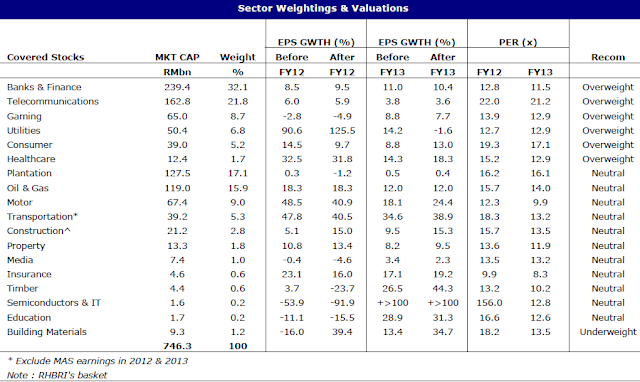
Sector-wise, our key overweights are telecommunications and banking, although we also have an overweight stance on the consumer, utilities, gaming and rubber gloves under the healthcare sector (see table below). We expect the high-yielding telecommunications stocks to remain relatively defensive for equity investors under the current market environment.

The banking sector, on the other hand, carries a 34.7% weighting in the bellwether index and, in our view, cannot be ignored, given the better-than-expected recovery in earnings momentum over the last two consecutive quarters. The year-to-date annualized loan growth stood at 11.9%, ahead of our and the consensus forecasts of 10-11% and 8-9% and the pipeline of corporate deals remains healthy. This suggests that banking earnings could continue to surpass expectations in the quarters ahead, which coupled with decent valuations and dividend yields vis-a-vis the FBM KLCI benchmark, would bode well for share price performance in the 4Q, in our view.
Source: RHBRI research report
Tuesday, September 4, 2012
New IPO: IGB Reit
IGB REIT comprises of Mid Valley Megamall (retail; 1.72m sf NLA) and the Gardens Mall (retail; 0.82sf NLA) with a total appraised value of RM4.6b. Currently, Mid Valley Megamall is 99.8% occupied and the Gardens Mall is 99.7% occupied. Based on the IPO price of RM1.25, IGB REIT’s market capitalization would be RM4.3bn, making it the largest pure retail M-REIT. Following closely behind IGB REIT in terms of market capitalization size is Pavilion REIT (RM4.08b), Sunway REIT (RM4.02b) and CMMT (RM3.02b).

What are the key selling points for IGB REIT?
- Prime asset with strategic location, huge catchment area and well connected transportation networks.

- Diverse based of tenants to sustain rental income.

- Low gearing provides ample room for acquisition growth. Based on IGB REIT’s Pro Forma Statement of Financial position, IGB REIT’s gearing ratio upon listing will be approximately 25.8%, which is below the average of listed MREITs of approximately 29.2% as at 31 Dec 2011. Hence, for future acquisition, IGB REIT has the flexibility to borrow additional RM1.1bn before reaching the statutory gearing level of 50%.


What's the fair value?
As shown below, different research house gave different fair value by using different method of valuations. To summarize it, the fair values estimated could give investors an upside potential of between 7.2% - 16%. Does this enough for you to consider to subscribe this IPO? Anyway, only 1% of the shares were being allocated to retail investors. Good luck.

Source: Various research report
Monday, September 3, 2012
The Norwegian Petrolium Fund
For those of you who want to learn more about the Norwegian oil fund, formally named Norway’s Government Pension Fund Global, perhaps the paper “The Norway Model” by Dimson et. al. (2011) could be of interest.
The paper discusses the oil fund and compares its investment mandates, dubbed the Norway model, with that of Swensen’s Yale model. While the Yale model focuses on alternative investments such as private equity, infrastructure and real estate the Norway model instead focuses on a widely diversified portfolio of traded fixed income and public equity. If you like, the Norway model tries to harvest beta while the Yale model tries to generate alpha.
The Norwegian oil fund is the largest sovereign wealth fund in the world with more than $600billion in assets. As a rule of thumb the fund owns roughly 1% in each publicly traded firm in the world. The fund is supposed to spread the oil-fortunes accumulated over a million years across several generations and it makes every Norwegian close to a millionaire (in NOK).
Now, I like the Norway model. However, there are two things I think I would change if I were in charge of the fund:
1) The real return expectations! Currently, the Norwegians expect the fund to generate 4% return in real terms every year. To me, this sounds a bit optimistic and it seems dangerous to build the state budget around these numbers (in the long run, they plan to spend roughly the real return each year). Particularly since the mean real return over the last 15 years is only 3% and the standard deviation is close to 8%....
2) The “war” risk! I would allocate a significant share of the fund to concentrated investments that will keep generate cash flows also if total Armageddon strikes. If the financial system suffers a complete meltdown, perhaps caused by a global war or something similar, it would be good to rely on other things than pieces of paper giving you the right to 1% of a firm in Asia or Latin America... I would allocate 5-10% to gold. I would buy protectable land and real estate that can be guarded. I would buy entire firms at home and in neighboring countries. I would also build up close relationships and make concentrated investments in certain countries in Africa and the like (like China).
In other words, a mix of Yale and Norway coupled with gold and disaster insurance would do it for me. Yaleway!
The paper discusses the oil fund and compares its investment mandates, dubbed the Norway model, with that of Swensen’s Yale model. While the Yale model focuses on alternative investments such as private equity, infrastructure and real estate the Norway model instead focuses on a widely diversified portfolio of traded fixed income and public equity. If you like, the Norway model tries to harvest beta while the Yale model tries to generate alpha.
The Norwegian oil fund is the largest sovereign wealth fund in the world with more than $600billion in assets. As a rule of thumb the fund owns roughly 1% in each publicly traded firm in the world. The fund is supposed to spread the oil-fortunes accumulated over a million years across several generations and it makes every Norwegian close to a millionaire (in NOK).
Now, I like the Norway model. However, there are two things I think I would change if I were in charge of the fund:
1) The real return expectations! Currently, the Norwegians expect the fund to generate 4% return in real terms every year. To me, this sounds a bit optimistic and it seems dangerous to build the state budget around these numbers (in the long run, they plan to spend roughly the real return each year). Particularly since the mean real return over the last 15 years is only 3% and the standard deviation is close to 8%....
2) The “war” risk! I would allocate a significant share of the fund to concentrated investments that will keep generate cash flows also if total Armageddon strikes. If the financial system suffers a complete meltdown, perhaps caused by a global war or something similar, it would be good to rely on other things than pieces of paper giving you the right to 1% of a firm in Asia or Latin America... I would allocate 5-10% to gold. I would buy protectable land and real estate that can be guarded. I would buy entire firms at home and in neighboring countries. I would also build up close relationships and make concentrated investments in certain countries in Africa and the like (like China).
In other words, a mix of Yale and Norway coupled with gold and disaster insurance would do it for me. Yaleway!
Subscribe to:
Posts (Atom)