Last week I got published in The Ecologist. The article was called A four-step guide to bypassing high street banks. This is my second article for the magazine (my first was on food speculation), and this time the aim was to sketch out how people might engage in financial protest, not by waving placards, but by changing debit cards.
Many people agree in principle that major high-street banks have too much power, and that they frequently abuse that power. Nevertheless, many individuals don't necessarily have the time, or inclination, to protest about it directly in the manner of the Occupy protesters. There's been a lot of discussion about how to make financial protest more inclusive (including this piece by Kenth Gustaffson on a type of ‘virtual occupy movement’), but perhaps one of the most profound (and often overlooked) forms of protest is to distance yourself from mainstream finance by withdrawing deposits and avoiding using the services.
The article is pretty straightforward. It goes through four (UK-focused) strategies:
You can move your money to a more socially responsible bank like the Co-Operative Bank, or to building societies and credit unions
You can invest savings in socially responsible alternatives, including certain investment funds and specialist investments with environmental or social benefits
If you need a loan, you can bypass the mainstream loan system and engage in peer-to-peer (P2P) finance or crowdfunding
If you want to go bold, you can try detach from the mainstream currency system and use alternative currencies
THE ANSWER: BREAK MONOPOLY
Bypassing mainstream finance is not necessarily easy or convenient, and it's not a solution to the deeper structural problems of the financial sector. Change though, needs to come from many different angles. Regulatory and policy changes are needed, internal cultural changes are needed, and more competition is needed. Moving your money and getting involved in alternative finance is one way to boost competition, and one way to support sustainable finance innovation. It's an act of protest, but in encouraging financial diversity, it's also an act of creativity.
Please do check out the article. Any comments are most welcome, and I’d dig to hear any other suggestions for alternative strategies that I might have missed.
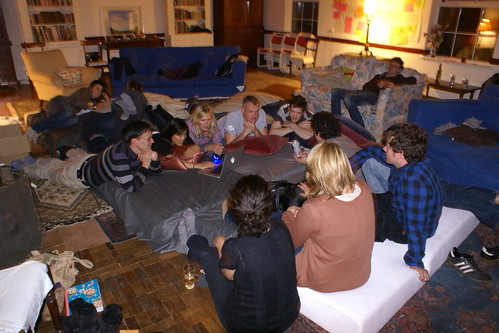
A few weeks ago a group of wayward individuals met at Waterloo station. We hitched a ride on a train going north into the English wilderness. Bertrand was forward-thinking enough to have brought beers for the journey, a skill he learnt in his 10 years working for Deutsche Bank as a structured equity derivatives trader. Next to him was Ingo. Ingo does things that make my mind hurt, which involves channelling and managing innovation and systems design, in Sweden. Behind me was Neil. He works for the Young Foundation, helping to design things called Social Impact Bonds, ways of allowing private investors to get involved in financing early interventions that might reduce social malladies. He was chatting to David, who specialises in design, and in particular, new means of mapping and visualising the financial sector. Bertrand started talking about social CDOs, and that's when people on the train started to look at us funny. A girl sitting next to me asked me who we were. Um, how do you explain that? We kind of work in finance, but at the same time are trying to disrupt it, alter it, play with it. I gave her my card. "Come to the dark side", I said, "there are cool things going on". Enter the Finance Innovation Lab.
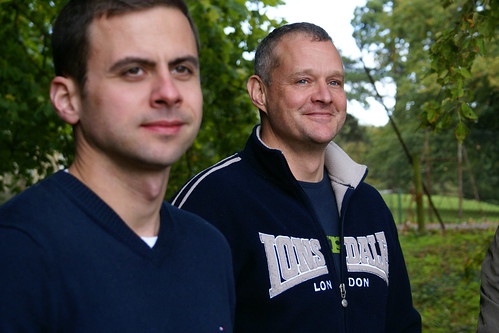
This is me, trying to talk on camera after three days of mind-disruption. We were talking financial reform and innovation, but most of all, the group of 21 of us were all together to discuss and map the potential future strategy and vision for the Finance Lab. The Lab was originally set up to bring people together under the common goal of finding out what a 'financial system that served people and planet looked like'. I'm a comparative newcomer to the group, but in the year or so that I've been hanging around I've seen the fantastic potential the Lab has to connect people, and to promote learning and collaboration. The next challenge though, is how to scale it up to the next level, to bring in new streams of funding, target more people, and incubate more projects. Jen Morgan, Charlotte Millar, Richard Spencer, Rachel Sinha, Tina Santiago, Maria Scordialos, Vanessa Reid and Hendrik Tiesinga set up the frameworks to help us to think about these questions, and then let it run. A particular discussion point concerned the extent to which the Lab should shift from its current role as a facilitating and connecting organisation, to an organisation with a more explicit focus on advocating specific policies. The process of shifting to a more political stance isn't likely to be easy, but that why Chris Hewett has come in to explore the possibilities for 'finance policy for a green economy', with support from the Gulbenkian Foundation, represented at the weekend by Louisa Hooper.
SPOT THE EX-GOLD TRADER
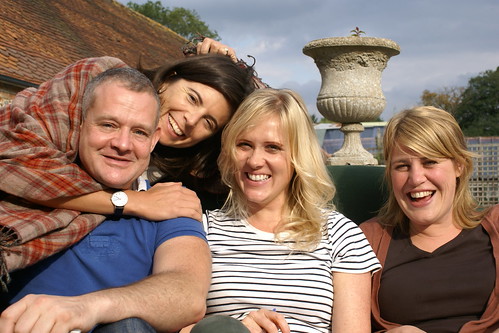
Note the beautiful setting, on the grounds of West Lexham, a fantastic enterprise on an old converted farm. Manager Edmund wants it to be a hub for community empowerment, permaculture, renewable energy and creative solutions for sustainability, so that suited us pretty well. In our crew was Niahm, a whirlwind helping to drive WWF's sustainable food initiative, Tasting the Future - concerned with issues around sustainable food systems. We had Bruce, one of the guys behind peer-to-peer lending site Zopa, and now launching Abundance, a means for retail investors to put their money directly into financing wind farms and solar energy. We had the guys interested in unorthodox monetary systems - including Ben, pushing the boundaries of the monetary reform debate, and Leander, working on nurturing the complementary currency ecosystem. I shared a room in an old piggery with Maxime, representing both France and the socially responsible investment community.
PURE INNOVATION
The Fellowship of the Ning
BERTRAND SHARES HIS FEELINGS
The Finance Innovation Lab is a great space for those looking to get involved in designing a sustainable financial system. The first point of contact for those who are interested in getting involved is the online network hosted by Ning, but the core team is working on setting up a new website with enhanced capabilities. The plans are grand. By 2013, I expect we should own a large part of Canary Wharf. Until then, we get our strength from diversity. It's certainly not just for financialismos. It's for anyone with an interest in sustainability, creative design, systemic thinking, chaos theory, food systems, climate change, social justice, and last but not least, all those who just like causing a little bit of havoc.
So I haven’t managed to get a blog post out for a couple weeks. That’s partly because I’ve been having some cash-flow management problems, due to some crap planning on my part and some unfortunate payment delays. This is an ongoing issue in freelance life, to smile through gritted teeth when someone at an organisation tells you the admin guy went on holiday and forgot to process your invoice. In a situation when one’s reserves are marginal, small frictions in the system can wipe you out.
Needless to say, when my landlord sent me an sms a few weeks ago saying ‘You haven’t paid your rent, and you have six months of bills to pay too,’ I got a deep down chill. My landlord is a cool guy. He only has one name, and our contract is informal at best, built on trust and belief in human nature rather than legal structures. That’s why he gave me some leeway, and that’s also why I didn’t want to abuse that trust. So I called up my friend George, and asked him what I should do. He wrote a song for me with some suggestions about how to deal with the house rent blues:
It’s an ancient blues, the house-rent blues, and financial services for people suffering from cash-flow irregularities are probably as old as the moon. Short-term loans attached to long-term shackles have long been the speciality of a certain class of societal demon called the Loan-Shark. I’ve been seeing the Loan-Shark in my dreams, under a bridge, at the crossroads of Highway 61 and Highway 49, right there in Clarksdale where John-Lee Hooker wrote the song. In that dream the Loan Shark says “35% interest per month, secured on your soul” and hands me a contract to sign. “That’s pretty steep” I say, “Are you regulated by the SEC?” He’s taken aback. “Hell no brother, but you can count on me.” I look at the small print on the contract. It says: “You can check out any time you like, but you can never leave.” Yes it’s true, the Devil uses clichés from the Eagles.
The dark desert highway of the Loan Shark extends around the world. You find them in Brazil, you find them in them in South Africa. In Bangladesh you’ve got the ‘5-6’: The guy that loans you 5 taka in the morning, and gets 6 taka back from you at night. That’s 20% interest in one day, which is about 7200% interest annually, uncompounded. That what you call raping the time value of money.
Anyway, in dealing with my cash-flow problem I decided to stay away from Brixton’s loan sharks and to take a look at the legal pay-day loan services. Payday loans are like advances on a salary. You show them proof that you will be getting paid at some point. They advance you the money. You pay the money back with interest when you salary comes through. It’s a way to tide you over liquidity crises.
There’s a big new payday loan outlet that recently opened up by the Brixton Academy, opposite the St. Barnados Charity Shop. I had to wait for a while to get served, and watched a women in her early 30s sort of plead with them for a two-day extention on a £200 loan that she couldn’t quite pay back yet. I’m not sure there was a pleasant story behind her situation, and the lady who served her was gently refusing. It can’t be an easy job dealing with people on the thin-edge of financial stability.
LO-FI FINANCE
When my turn came, I got served by a young guy who was quick to tell me that the company is actually American, and that they have six outlets in the UK, the Brixton branch being a flagship of sorts. As for the terms of their payday loan: 25% per month, which is 300% per year, more modest than the classic loan shark, but ridiculous costly nevertheless. In order to get a £625 pound advance on your paycheck, you’d have to pay them back £780. I asked what would happen if I didn’t pay back in time. He said the matter is then passed on to their payment delinquency service, who would organise an ‘alternative payment plan’.
I reckoned I might check out some of the online payday loan services instead. Payday UK comes top of the search results. Again, the terms of the loan are 25% interest per month. Yep, for a £400 advance, you pay back £500 in a month. Wonga is another one, only this time it has a deceptively cuddly name and even worse terms: For £400 loan, you pay back £525 within a month. This really does not seem like a sustainable business model and people looking for £400 advances aren’t really the kind of people who should be spending £125 on liquidity management. There must be social enterprise models waiting to emerge in this space…
Out of curiosity I visited the pawn shop. Pawn shops allow you to pledge gold or jewelry as collateral in exchange for a loan. I didn’t actually have anything valuable to pawn, but if I did, their deal was better, at 6% interest per month.
WILL YOU ACCEPT MY AMULETS AS COLLATERAL?
The lower interest rate is a due to the fact the loan is secured on some valuable bounty, so if you don’t pay back, they just keep your stash. Collateral lowers your ‘cost of capital’ because it provides protection to the lender, and it’s one of those unfortunate realities that those who possess collateral tend to be wealthy individuals. Some might say that that’s a reason why wealth tends to concentrate around existing wealth… ahem, Mr. Marx.
So what do you do when you don’t have collateral to base a loan off? You label yourself an entrepreneur, and you raise money against the fabulous future wealth that you claim you'll create. That’s what I was thinking when I went to a talk on crowd-funding, given by Theresa Burton from a company called BuzzBnk. The idea behind crowd-funding is that you attract small-scale (philanthropic) investors to contribute to your cause. You need a catchy story to get people to invest in you though, and ‘Can you guys give me £400 so that I can pay my landlord’ is not going to cut it. On the other hand, ‘Can you give me £3000 so I can finish my book’ just might…. Did I mention that I’m writing a book? (more on this topic later)
In the end, time constraints required that I turn to the most powerful and ancient financial service: Angel investors…. By which I mean friends, the great providers of flexible and low interest loans. Thanks guys.
The moral of the story then is that I continue to live an unsustainable life and have a great new idea for an unprofitable business: A freelancers’ co-operative to help London’s army of freelance workers deal with the ordeals of invoice delays. This sounds like a good idea, to sink my energy into something which will have… um …. marginal and sporadic cash flows attached to it, at best.
But who needs stability when you have one bourbon, one scotch, and one beer…
As for how I defeated the Loan-Shark, I had another dream last night: